Well, we lost the weak hive. Anson noticed there were fewer and fewer bees down to a population that he did not think would survive. He could not identify the queen, though we knew that would be difficult because she was unmarked and small so would easily blend in with the worker bees. He also only saw larva, and based on this blog post charting development cycles we can conclude she was laying 6 days prior. However, this was not sign enough she was prolific. For all of these reasons Anson decided (under Poppop's mentorship) to combine it with the other stronger hive. So, now we are down to one hive which hopefully we can keep alive until next spring when the pollen and nectar will flow enough for us to get some honey out of this whole deal!
After some discussion and thought we have decided that our queen source (Bailey Bee Supply in Raleigh) is of poor quality and that we should find another supplier next year.
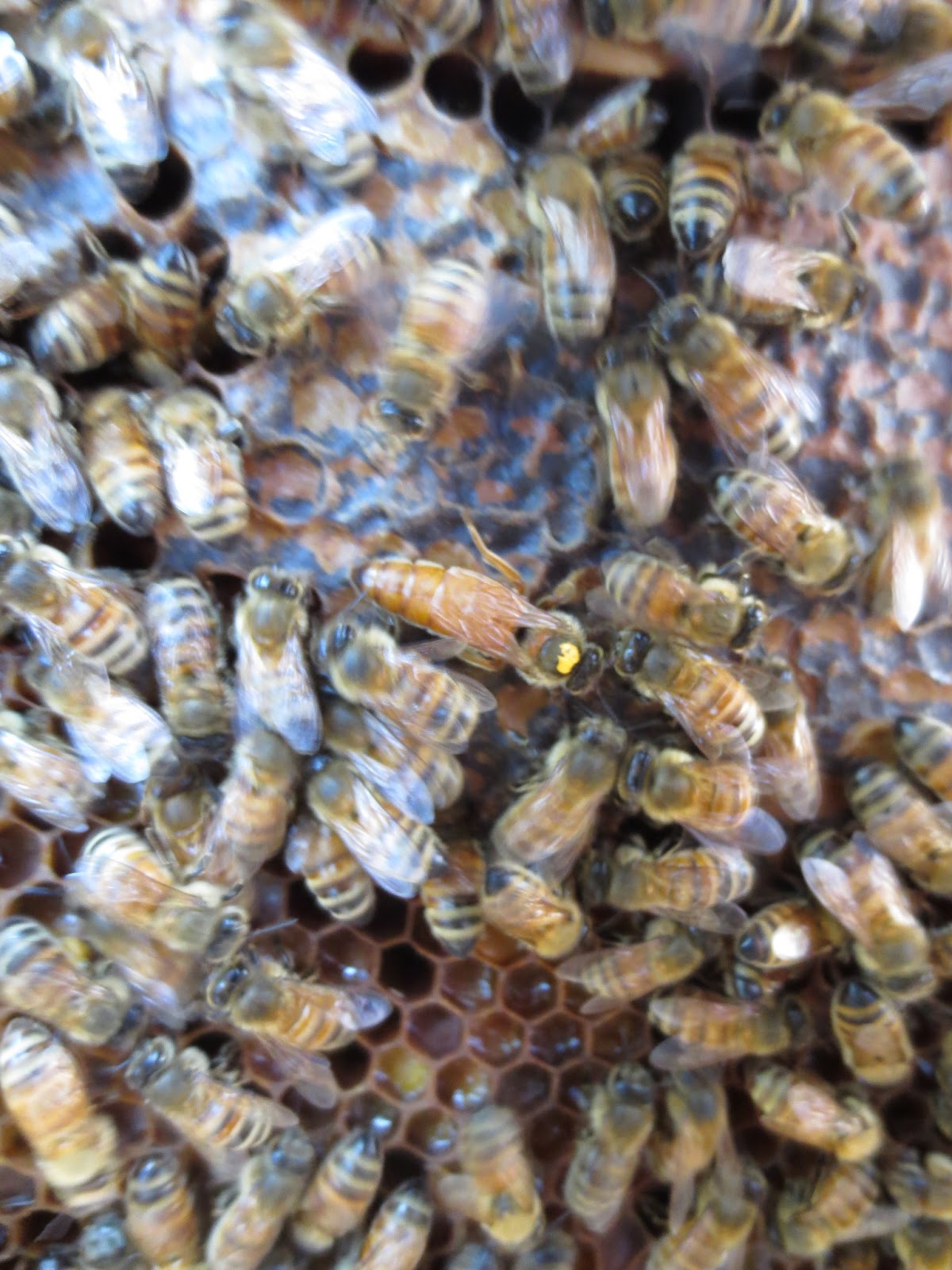
We encountered a bee problem again: a weak queen. So we've ousted her and replaced her with a new, hopefully more powerful queen. The new queen is small though, so we're slightly concerned her reign may not be much better than the incumbent's. I've tried to photograph the new and the old queens for you but they're always on the move and their attendants get in the way, so I only have one decent shot to share. They come in a small box with about 4 attendants and are plugged with sugar that they eat away to slowly be released into the new hive. That allows the bees to reorient themselves with the new queen's scent so that they accept her.
Ousted queen can be spotted by her large blue marking
Most queens are marked with a dot, as explained in this previous post about queens, but this new queen is not. We are not thrilled about that because combined with her small size she will be very difficult to spot.
The original queen cost $100 and came with 3 pounds of bees. Since we already had a mostly established hive and just a weak queen we had the option to either 1) combine the failing hive with our more successful one and hope they winter over or 2) buy another queen for $30. We opted for the latter option and have our fingers crossed she begins laying a lot in the next week or so. We'll keep you posted!
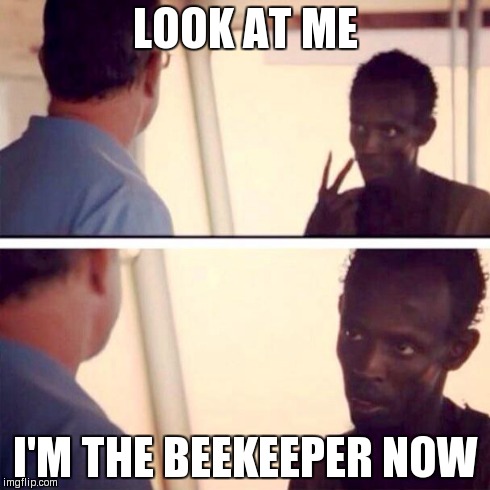
We're back in beekeeping business, y'all! We had a bit of a hiatus while I was pregnant and then caring for a baby. We did still have bees through much of both of those life stages but it was very difficult to find the time to get out to the bee yard. Then, we did lose both hives. I felt defeated and frustrated with the hobby altogether. We were rewarded with about 20 pounds of honey, which seems like a lot, but didn't feel like a decent return on our investment. Anson still wanted to continue while I wanted to quit so he said he'd take the bulk of the responsibility. Actually, what he said to me was a play on a Captain Phillips movie quote when the pirate takes over the ship and says he's the captain now:
He does the two fingers and says the line a lot and it hasn't stopped being funny yet. He was always very supportive but now he's actually very exited about beekeeping!
So, we're back! Anson bought two packages of 3 pounds of bees each.
Each package comes with a queen in a small box that is corked and then plugged with a bit of sugar.
He needs new gloves! These have duct tape on the fingers.
You open the package, pull the cork from the queen's box, and shake the 3 pounds of bees into a hive. The bees will eat the sugar plug which allows the queen to be slowly introduced to the colony. The bees get to work busily pulling out wax comb and foraging straight away. We installed the two packages today so wish us luck!
Tomorrow marks the one year anniversary of this blog and September marks our first full year as beekeepers. I'd say both have been successful! I've (mostly) stuck to my commitment of blogging about once a month and readership is as could be expected with a niche topic. Here is a global view of where my readers view my blog:
Over 1200 page views to date!
I'd love some feedback regarding the blog if you have any regarding content or otherwise.
Our first year as beekeepers has been a great learning experience. We've not yet gotten the opportunity to enjoy the fruits of our labor in terms of actual product but we have gotten to enjoy many other aspects discussed as reasons to keep bees in this blog post from last year. The connection with nature is really my favorite part. I love listening to the bees buzz and watch them zooming in and out of the hive. It's amazing to watch them work. Two of the most inspiring bee activities to me are watching the bees head down working inside of a cell and watching a new bee eat her way out of her cell to life. It's incredible and no other bees can help her out. Then she immediately gets to work. It's very tranquil to just watch them go about their tasks.
Bees head down working inside of cells and one bee emerging to begin her life working for the hive
Also this year we lost two hives and got the opportunity to start two new ones, both of which are thriving today. We've had hive beetle issues, and learned about wax moths the hard way. We have gotten stung, dealt with robbing and lit the ground on fire starting the smoker. Our neighbors have been supportive and even appreciative of the pollination our bees have provided. Poppop has been a great mentor to me and it's been nice to have the opportunity to learn from his 20+ years of experience. Also, I've made some friends from the Wake County Beekeeper Association and have enjoyed the various community activities related to bees.
Overall, it's been a great year and I am thankful for the experiences. Does one year mean I'm no longer a newbie?
We did not have enough honey to extract ourselves this year but we like to help Poppop extract his so we headed down to Hampstead. This post explains our extraction process.
First we collect all of the frames off of the hive. We have to minimize the bees left on the frames so that when we move inside we are not working around lots of bees. This is actually a difficult task. We use a spray that the bees don't care for to try to move them away and then we brush as many bees off as we can and place them in a wheel barrow with a towel on top. Then we move those boxes of frames of honey to the room where we extract. The room is my grandparent's workshop where they work on their various hobbies and it is has a cement floor with a drain. We cover the floor with newspaper so we can easily clean up from any honey spills.
Boxes of frames ready for extracting!
After we have gathered the frames we will extract from, we go frame by frame to cut off the wax cappings sealing off each honey comb. We use a hot metal knife and sometimes a metal toothed pick to do this.
A frame of capped honey comb
An electric metal knife and a metal pick help us get to the good stuff
Melting and cutting away the wax capping. See the cells that are still capped at the top? That's where the metal pick would be handy.
Then, we place each frame into a centrifuge and spin away! The honey comes flying out of the comb and onto the walls and bottom of a large plastic barrel. Then we strain that honey through cheesecloth and two metal strainers.
An above view of the centrifuge and straining bucket over a floor covered with newspaper for easy cleaning.
The last step is bottling the honey which we normally save for another day as sanitizing the bottles is a bit of a job all in itself. Poppop likes to add a fancy label to his jars if they're gifts for non-family members or if he intends to sell it.
Last year we gathered over 600 pounds but this year poor Poppop only got about 50. It's sadly been a tough year for bees. Hopefully we both have better luck next summer!
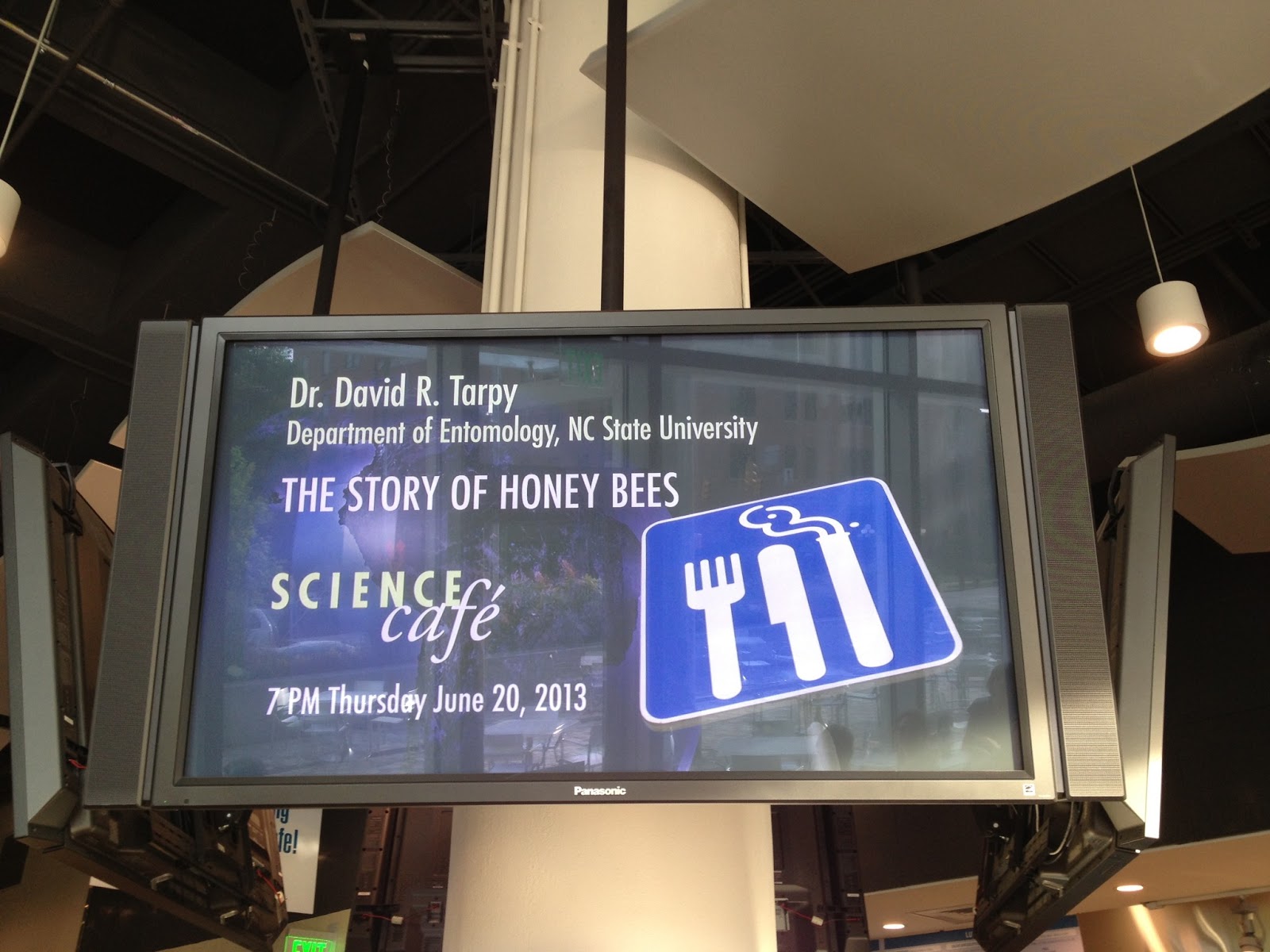
Anson and I went to the Science Cafe at the Museum of Natural Sciences last week to hear an NC State Professor of Entomology talk about bees. He gave a brief intro and then opened it up for Q&A. The session was fun and people asked a lot of great questions. I was surprised at the quality of the questions, actually, especially considering how diverse the crowd was.
After the session, I approached Dr. Tarpy to ask about the affect of sun or lack thereof on my hives. He said that it would be preferable to have morning sun but it is not imperative. Then he mentioned that a grad student of his is conducting a study about diseases of urbanized bees and requested I contact the student because of the location of my hives being downtown. The following day I did and the student was excited to have hives in Five Points to study. He asked if he could come by 3 times in 3 week intervals to take a sample of 60 bees each time from my hives. I declined to include the nuc in the study and offered the stronger hive. He came by this morning with a net and about 10 tubes for bee collection. He is only capturing foragers as the study includes some feral hives and he would not be able to collect anything but foragers from those hives.
After standing at the entrance with a net for 30 seconds, Holden would then swoop the net around attempting to contain as many additional bees as possible. Then he had to insert a tube into the net and try to get them all to go inside the tube. He did this until he had collected 60 bees which took almost an hour.
Attempting to capture all the bees in the net into a tube.
Tube of bees.
Hopefully by the fall he will have some analysis for me. He did keep a watchful eye for any disease-like activity and noticed a bee that carried out a dead larva from the hive. He was interested but not concerned about that being related to disease.
Dead larva we examined after noticing a bee carried it out of the hive and dropped it outside. There were a few others on the ground near it.
I'll keep ya posted about the results of the study once I get them back. It will be a long time though.
I lost both of the hives Poppop gave me last September. About a month ago we picked up two more: another one Poppop gave me and one was a nuc that I bought from Mr. Knox.
About to start another bee driving adventure! This one went much more smoothly!
A nuc is a 5 frame mini-hive that should include a mix of frames including brood of varying stages of maturity, honey stores, and pollen. All of the frames should have drawn comb and the queen should be less than a year old. Mr. Knox is is an 80 year old master beekeeper that I met at the Wake County Beekeepers Association and he has been keeping bees since he was like 13. Unfortunately, the nuc he sold me was weak as it had only 4 frames of drawn comb, and not enough bees. I knew that it should have 5 but I figured it wouldn't make much of a difference. Well, a month later and it's clear that it does make a difference. The hive is very weak, has hardly grown, has yet to finish drawing that 5th frame of comb, and has so few bees I'm worried I'll lose them again this winter.
The hive Poppop gave me is much stronger and already has 2 supers on it! Supers are the boxes on top of the larger boxes that are meant for brood and some honey stores for the bees. The supers are slightly smaller boxes and frames that the bees fill only with honey and no brood. We ensure that there is no brood in these boxes by excluding the queen from getting to them using what's called a queen excluder. This way, when we go to extract honey we are sure that we are not disturbing the queen or her brood.
This is a frame from the honey super. The cells are filled with delicious smelling honey. The white area are cells that have a sufficiently reduced moisture content and have been capped with wax by the bees to best preserve the honey.
The nuc is on the left and the hive from Poppop on the right. You can certainly tell which one is healthier!
That wire rack beneath this set of frames is the excluder as it is too narrow for the queen's larger body but is just right for worker bees to be able to slip through.
Both hives are weak really, but the one Poppop gave me is much happier than the other and hopefully will survive this winter for me! I have identified two major problems and only one is really solvable. The first problem is that the hives really need to be in a sunnier spot. I suspect that the reason these hives are under-active is because they are not getting enough direct sunlight. My book tells me that bees become "listless" in the shade which I do believe describes my poor bees but there's not much I can do about that living in the City of Oaks in an old neighborhood. The second problem I see is that I really need a mentor to come check my hives with me about once a month. I have asked the association for a mentor and also asked around at the club but so far have not had a lot of luck other than people willing to offer verbal advice. I will continue to pursue finding a mentor though! Also, I can lean on the support of a forum in the meantime.
Over the past month I also had the opportunity to learn a valuable lesson. Poppop told us when we started our adventure of becoming beekeepers that we need to keep all of our unused boxes enclosed with moth crystals.
We were mostly diligent about that until the week we picked up the new hives. See, you're supposed to air out the moth crystals for 24 hours before putting a new box on the hive. We figured the nuc would need a new box in a few days and set one out in the basement. Within the week we had wax moths. A little infestation is, according to Poppop, not the end of the world as the bees can clean and repair any damage. The wax moths eat through the comb and also make a disgusting webbing all over it. I noticed the problem but wasn't really sure what to do about it at the time because I wasn't sure when we'd need the box for the nuc. Well, I should have figured something out because now it's been down there for a month, is covered in webbing and moth larva and is dripping and crumbling wax to the point that it was too gross for me to get near. The frames were no longer salvageable and we had to throw them away. While the frames themselves are not expensive, the drawn comb is a big advantage to the bees so that they do not have to waste energy pulling new comb and can focus on making honey! So that you can also be repulsed, I took a picture of the frame covered in larva. I almost vomited just taking the picture. But I'm looking at it as a good thing because now I won't ever let our shed of unused boxes be without those crystals!
You can see where the moths have eaten through the comb
I'm really not sure why it is dripping wet like it's melting but it has left a puddle of wax on the basement floor. The larva is there in the middle but perhaps not close enough for you to get the willies. Take my word for it, it was nasty.
My next blog post will be a lot more fun as we help Poppop extract his honey. I may even get a jar or two of my own from my good hive! Now that would be awesome! I can't wait to taste it. And as one of my 12 valued readers perhaps you could join me!
In a single collecting trip, a worker will visit between 50 and 100 flowers. She will return to the hive carrying over half her weight in pollen and nectar. Sometimes when I watch the front of my hive the bees will be visibly weighed down from all of the pollen. Here is a photo (that I did not take) of a bee with a lot of pollen on her legs in what is called her "pollen basket"
A strong hive will have up to 100,000 bees in the summer. An average hive has more like 40,000-60,000 depending on the season, where 30,000 of those are working on tasks inside the hive and the other 30,000 are working outside the hive. I suspect my hive currently has about 20,000 bees but who's counting!?
Bees travel up to 5 miles to gather pollen and nectar and can fly up to 15 miles per hour! We charted out the possible foraging radius (hivetracks.com) and saw that our bees could really be all over downtown Raleigh including all the way to the NC State Rose Garden.
Foraging bees teach other foragers where to find honey by using the waggle dance:
Honey bees work around the clock. They do take naps or sleep for a few hours at a time but even at night they can be found working building or repairing combs.
The queen lays about 1,000 eggs a day but can lay up to 2,000 in the spring and summer when an increased population is demanded.
Bees are not born into an assigned task for life, rather they progress through different jobs as they age. The roles are as follows:
The honey bee only dies when she stings an enemy with soft skin, such as a human, but they do not die when the sting other predators like insects.
When bees buzz they produce a negative charge. Supposedly pollen has a positive charge and therefore the pollen clings to the bee through an electromagnetism.
Theoretically, when bees smell smoke they fill up on their honey stores. This expands their abdomen which makes it more difficult for them to bend, and thus it should make their stings less deep and severe.
Bees are able to solve the traveling salesman problem by determining the fastest and most efficient route to multiple destinations and they're able to solve the problem faster than a supercomputer. They are also able to count to 4, but only 4. This is based on a study where pollen was placed in the fourth tube and the bees were able to repeatedly select the fourth out of a series of tubes.
The queen does not necessarily mate with a drone from her own hive. She mates with about 20 drones that happen to be around when she does her mating flight. This means that the hive is not all inbred but is a mix of at least half different genes. During that mating flight the drones will deposit upwards of 90 million sperm in the queen's oviducts. The queen, however, will not use all the sperm. She stores about seven million sperm to use throughout her life.
And finally, my favorite fact yet: The drone dies in the mating process: the wind pressure developed during his attempt to catch and mount the queen actually causes him to explode with an audible pop as he ejaculates inside of her. He then falls off the queen, usually leaving a portion of his phallus inside her.
For more amazing information I encourage you to watch this documentary from PBS NOVA called Tales from the Hive. It is really fascinating and the footage will have you awed. There's a corresponding article about how NOVA was able to capture the footage which is pretty incredible.
Anson and I got the opportunity to check the bees today as it is beautiful and warm. You can only work the bees in the winter on warm days, and those often fall on days where I have work or other activities so I was pleased to be able to finally get out there. And we had great news! We spotted our queen! She's not laying but that may be because I have not provided her adequate space to lay as all the frames are full of honey. I'll add some space for her soon but for now I'm just happy to still have a hive and a queen!
She has a yellow marking to allow the beekeeper to more easily find her, even though her longer body makes her distinguishable anyway. The breeder uses different colored dots based on the year:
White - years ending in 1 or 6
Yellow - years ending in 2 or 7
Red - years ending in 3 or 8
Green - years ending in 4 or 9
Blue - years ending in 5 or 0
So if I am able to get another hive going this year and purchase a queen she will have a red dot. I am on a waiting list for a nuc which is a box with a queen, 10,000 bees and 5 frames of wax that has already been drawn out into the comb, of which two or so frames will be full of brood and the other two or so will be full of honey and pollen. This is advantageous because the bees will need to eat 8 pounds of honey to produce one pound of wax and they cannot spend their energy making wax when there is nectar to forage in the spring! So, here's to hoping I am off the nuc waitlist soon!
This Thanksgiving we were sitting on the porch at my in-laws and a bee flew in that did not look like a honeybee but didn't look like any other bees I'm familiar with either. I decided I'd like to do some research on the different types of bees (I found that there are over 20,000 species!) and I figured I might as well share the information with you too! So, this post is not really related to my becoming beekeepers, but hopefully you will find it interesting anyway.
None of the photographs used in this post are mine. I found them all via Google Images; however, I tried to credit their rightful owner where possible in the captions. Also, the information is not my own research, so sources are cited below where I have paraphrased someone else's work.
Currently, there are only 7 recognized species of honeybee with a total of 44 subspecies [1]. They are eusocial, which means that they live in a cooperative group with a caste system. Honeybees have been domesticated for over 3000 years. I have a blog post coming about cool honeybee facts so I'll leave this section light.
Photograph by Stephen Buchman via nationalgeographic.com
These bees are also known as Killer Bees as they are the most defensive and will peruse their attack the longest of any other variety of bee. Although a hybrid of the honeybee we know and love, this bee is not desirable for the average beekeeper as they swarm more frequently and further, as well as the issue of defensiveness.
The best way to tell the difference between Africanized bees and European bees is in a lab through testing [2]. Although there is a slight difference in size it is very difficult to tell the difference by just looking. In the picture below, the Africanized bee is on the left, European on the right, however, I don't think the coloring differences are of note, only the slight size differences.
Credit to Scott Bauer, USDA-ARS
The Bumblebee
Kingdom: Animalia, Phylum: Arthropoda, Class: Insecta, Order: Hymenoptera, Suborder: Apocrita, Superfamily: Apoidea, Family: Apidae, Genus: Bombus, Species: various
So cute! Bumblebees are sweet and soft. I actually pet them because they don't normally sting. There are over 250 species of bumblebees.
Cute bumblebee from Photos.com? Sorry, not sure on this one...
Bumblebees are often found foraging for nectar and pollen similar to the honeybee, however, they do not produce enough honey to attempt to farm them the way we do the honeybee. Also, their nests are different in that they have much smaller colonies (50 bees instead of 50,000), sometimes built in the ground. The queens hibernate over winter and then form a new colony in the spring. She does this on her own, building wax posts and laying eggs to begin a new colony. [3]
Carpenter bees are usually found flying around the eaves of houses or near other wooden areas of structures, like a deck. There are 500 varieties of carpenter bees. Some live in small nests together, but most species are solitary, living in nests tunneled in wood.
www.buffaloexterminating.com
They bore holes into the wood and use the tunnels to raise brood and store nectar. It is possible that these holes will be used over years at a time and in those cases, the tunnels can run several feet long. They do not eat the wood, but reform it to make side walls that are similar in consistency to particle board to raise brood. In the image below you can see the tunnels and the smaller brood cells.
www.fs.fed.us
The Wasp (Hornets & Yellow Jackets too)
Kingdom: Animalia, Phylum: Arthropoda, Class: Insecta, Order: Hymenoptera Taxon: Aculeata, Superfamily: Vespoidea, Family: Vespidae, Subfamily: Vespinae, Genus: Dolichovespula, Species: various
This one actually looks kind of creepy to me. Anson once stepped in a yellow jacket nest and had about 30 stings all over his body. They kept stinging him until he swatted them dead. I watched and worried from afar. He was fine though, and didn't even have much of a reaction.
Yellow jacket: Special thanks to Laura Meyers of laurameyers.photoshelter.com
The term wasp as a species covers over 100,000 insects, including hornets and yellow jackets. They are actually not even a bee, but I'm including them in this post because, well, I didn't know that and I'm assuming you didn't either! Another cool thing I learned is that almost every insect has a corresponding wasp that preys upon it or parasites it. They are sometimes used as a natural form of pest control as they prey mostly on what is considered pest insects, like caterpillars, crickets and flies [5]. Wasps have annual colonies like the bumblebee that is rebuilt each spring. Wasp queens also go dormant through winter, hiding in wood crevices until they reemerge. They do not reuse old nests to start a colony. Unlike honeybees, the wasp can sting multiple times because they do not lose their stinger in your skin.
www.allcountypestcontrol.com
Because there are so many varieties of wasps there are also lots of forms of nests. I bet the bees that killed Thomas Jay in My Girl were wasps and not bees if my memory of the nest is correct. The nest Anson stepped in was a ground nest, which you can hardly tell is a nest at all. You've probably seen a small grouping of cells under a house at some point. There are even wasps that make nests out of mud:
Uploaded to wikipedia by a user named Pollinator
Paper wasp nest from www.advancedwildlifecontrolllc.com
A hornet nest from Wikipedia. I think this nest is really pretty!
Cat Bee
And then there is the little known cat bee. This bee is also soft but surprisingly unpredictable.
This is just a joke. It's from this video:
Citations:
1. http://en.wikipedia.org/wiki/Honeybee
2. M. K. O'Malley, extension assistant, J. D. Ellis, assistant professor, Entomology & Nematology Department, Institute of Food and Agricultural Sciences, University of Florida, Gainesville, FL 32611 and A. S. Neal, extension agent, St. Lucie County, Ft. Pierce, FL.
3. http://en.wikipedia.org/wiki/Bumblebee
4. Stephen B. Bambara and Michael Waldvogel, Entomology Extension NCSU 5. Jeff Hahn, Phil Pellitteri, & Donald LewisUniversity of Minnesota Extension
Which was no big deal. I'm a confident beekeeper and stings do not bother me. Haha. This is only partly true... Here are some pictures of my neck:
Bee sting on my jugular 20 minutes later
and 4 hours later
As you can see, this sting is really not that big of a deal. It hurt a little bit and now it's swelling slightly. Totally manageable. And so was the one I got a few weeks ago on my thigh. It didn't bother me and only lasted 3 days. No worse than a mosquito bite, to be honest.
But having a bee stuck in my hair is a totally different Audrey. Clearly I did not fasten my veil very securely this morning and a few bees got inside. I was OK with the situation and walked away to get them out. When one stung me on my neck I was still relatively calm. But once I realized there was one tangled in my hair (again -- this had happened before about two years ago) the drama started. I removed my jacket and went upstairs to a mirror hoping I could get it loose before it stung me. The buzzing was getting more and more intense. You can tell by the sound if they are serious about stinging you. I think both the bee and I started to panic at that point. I tried to tell myself that the last time this happened it ended up fine as if the scalp was some sort of special zone of skin that isn't effected by stings. Logic and reason did not convince me to calm down and I ran outside screaming for Anson like a child or a lunatic. He did not appear instantly, unfortunately, so I screeched louder and shook my head like I was at an 80s hair band concert. As Anson came over the tears started and I couldn't calm down. It was a total meltdown. He just walked over and crushed my hair in his hands until the buzzing stopped. It had stung me moments earlier and I didn't even care, I just wanted the bee out of my hair. I am such a baby! Oh, and our neighbor was outside. She said nothing.
Anyways, there is more important information to talk about today than these stings which do not even hurt: We are losing our other hive. We are so sad about it. During the check today we only found 4 or 5 brood cells, and if you recall from an earlier post, this is not good news. We likely have a bad queen and will lose this hive as well. We could be optimistic and say that she is just slowing down for winter, but I don't think it's normal to slow down this much. In my first blog post I mentioned that Poppop had requeened both of our hives for us. This means that he bought new and young queens for us hoping that it would mean we had a strong hive starting out. We suspect that all of these queens he purchased were bad or weak. (Poppop is also losing one of his remaining three which he had requeened at the same time.) We lost the other hive a few weeks ago and now we cannot find enough brood in the second one, likely leading towards its inevitable demise. Our adventures of becoming beekeepers may have a hiatus through winter. Once spring comes around we can purchase new bees and queens and try to start over.
Anson says we had a beemergengy, that we had to act beemediately and that it was unbeelievable but I just said you've got to bee kidding me. A little less creative. We indeed had some bad bee news this weekend. It started out on Friday for our first real beekeeping activities. Like I said in a previous blog post, the main responsibility a beekeeper seems to have is to ensure the queen is alive and well. The way to check for this would ideally be to find her but that is challenging among tens of thousands of bees. The other way is to find eggs, larva or caped larva. This evidence of brood would lead the beekeeper to the conclusion that there was a healthy queen laying recently. Well, on Friday when we checked we did not see any evidence at all of brood. We called Poppop and then a mentor from the Wake County Beekeepers Association and determined that there was no queen and that the only option we had to save the remaining bees would be to combine the hives down to one hive. Anson and I are both so disappointed. However, this has been and will continue to be a good learning experience!
Where did our queen go? Well, it seems we never actually had a queen. We can conclude this by looking at the development cycle of a worker bee:
Poppop told us that he had replaced both hive's queens before giving them to us. To do this, you can make a new queen or you can buy one from an apiary. Poppop buys his from Mr. Tapp of Busy Bee Apiaries in Chapel Hill. They mail him a queen in a tiny box. First, he has to locate the old queen and remove her. Then there is a process to introduce the new queen. For our hive without a queen he said that he was never able to actually locate the old queen and that obviously the bees must have rejected the new queen.
A hive cannot survive without a queen. So, what we had to do was combine the hives. The upside to this is that the one hive will be more populous, stronger, and get an earlier start in the spring. We can then divide the hives back into two. My bee mentor said he'd come help me do that. We'll have to buy or make a queen. I have no idea how to do any of this so it will be fun to learn.
The hives we started with each had 2 boxes. To combine them we had to break down the weak hive into just one box and introduce it to the strong hive. Each box has ten frames. We chose the ten choicest frames that were the heaviest with honey to leave with the bees and were supposed to remove the other ten and store for the winter. Before storing, however, Poppop recommended we leave the frames in the freezer overnight to sort of sanitize them. We have a very small fridge and we had plans so we decided, stupidly, to leave the box of frames on the porch to deal with when we got home later. Well, oh my god, was that a mistake. We came home to a cloud of bees. It was insane. It was actually very alarming. Our awesome neighbors said they could hear the roar of bees buzzing from their porch. I took a 15 second video of the feeding frenzy that was ensuing on our porch to share with you:
Luckily the bees all go home at night so we let the chaos continue and went to have dinner and see Batman with friends. We came home later and the box was free of bees. We put it in a trash bag, took a couple out for the freezer and put the rest in the shed. Everything is much calmer now. And still no stings for either of us.
Unfortunately, there are a lot of dead bees out by the hive. It makes us sad. I'm not sure why there are so many dead but there's enough I probably need to sweep them all away. Hopefully everything is going OK and there will bee no more problems.
You may be wondering why someone would want to keep bees. Anson and I asked ourselves that question during the bee-filled van ride home to Raleigh. Comedian Eddie Izzard has some funny things to say about keeping bees:
Well, there are many reasons one would want to keep bees. Here are the top reasons Anson and I are interested, listed in order of importance to us:
Honey -- The benefits of honey are plentiful and there's even a website dedicated to the benefits-of-honey.com but to name a few:
Immune system booster; Antioxidant; Probiotic
Potential allergy immunity
Sore throat relief
Good for your skin: heals wounds and burns, moisturizes
Delicious
Connect with nature
I've read that beekeeping reduces stress (but I have no stress!)
Anson and I saw a new bee emerging from its cell today. They have to chew their way through their wax cell to get out as adults. It was almost emotional to watch.
Education
Bees are fascinating! I'll make a blog post on why later. I've been making a list of cool facts to share. I'll also try to take pictures of bees doing bee things.
Easy and rewarding hobby
Bees are low maintenance and require minimal effort and time to keep
Honey is a great gifts for loved ones
Beeswax can be used to make candles, lip balm, hand salve, and more. I think we'll likely make candles and not the latter two but we could if we were so inclined!
Pollination
I heard in a documentary that 40% of our food is dependent on bees in some capacity. 75% of the US's fruits, nuts and vegetables are pollinated by bees. Pollination is so critical to our food supply that bees are shipped all over the US to crops as they come into season. This has become a $15B industry. If you think about the need for pollination for our food sources, you'll see that bees are critical to our world. For example, without bees to pollinate alfalfa we would have no hay to feed cattle. Circle of life stuff. But Anson and I are just happy that our gardening neighbors will benefit. We also want to plant blueberries next year.
Bees are in trouble and need our help!
In 1940 there were more than 5 million managed bee colonies. Today there are less than 2.5 million. The following things are putting bees at risk
Colony Collapse Disorder
Increased use of pesticides
Invasive parasitic mites and beetles
Other theories abound for the vanishing bees (such as cell phones) but I won't name them all
Telling people we are going to be beekeepers prompts some interesting questions. My favorites so far are, "Are you going to make honey?" (alternative includes "Did you make honey?"), "Does wearing yellow make them want to attack you?", and "Are you going to name them?". I'm 90% sure the last one was a joke, especially considering that one came from a very fun friend. So, if these are the types of questions you might have, don't feel bad, you're not alone. I also am learning. And Anson learned the hard way that the color of your clothing does matter but that it's dark colors, not yellow, that seems to anger bees. Also, polarized lenses in sunglasses or scented deodorant or shampoo are no-nos in beekeeping. We did name our hives: we have the White one and the Green one.
The question "Are you going to make honey?" seems the most common of the questions and I've been asked it several times. It's similar to asking someone with chickens if they are going to make eggs. Bees make the honey and essentially we take some once (in some cases twice) in the summer in exchange for a well-kept place to live. This also gives the bees more opportunity to work and pollinate more plants instead of ending the season early with enough honey reserves to last the winter season.
While I am learning, these things I already knew. This weekend was filled with new learnings though as my Poppop gave us some hands-on training. He showed us how to check for a queen, which seems to be a beekeepers main task throughout the year. One way is of course to find her. She is longer and has a different shaped body than the rest of the bees. Another way is to spot her eggs or larva. If you can spot eggs or larva you know that she is laying and therefore exists. Our hives both have queens, however the laying pattern of the green hive is scattered and weak so we will have to feed them in an effort to increase the strength of the hive. I'll do this tomorrow. The food will be a sugar water solution 1:1. Or was it 2:1?... I'm still learning!
Poppop teaching us about the laying pattern
Anson and I are having a lot of fun already! We've gone outside just to look at the hives about 6 times in the last 24 hours. This has also increased the cat's interest in the area. She may have to learn the hard way not to sniff around there!
So yesterday was the big day! We drove the hives the 2 hours from Hampstead to Raleigh with Anson wearing his bee suit the whole way. It was an experience neither of us will forget any time soon. I laughed so hard my abs hurt, just laughing out of the sheer ludicrousness of the whole idea. Who drives a van full of bees? We must be crazy. But we are crazy awesome.
Anson and I ready for the drive to Raleigh
Anson with his full bee suit to Raleigh
At first, we noticed about 10 or so bees flying around but this was only about 10 minutes down the road. At about 30 bees and15 minutes in we decided to stop and see what was going on. We stapled down the screen blocking the hive "front porch" and kept going. After about 5 minutes there were another, say, 30 bees.
Maybe 30 bees on the back window after our first stop
We tried again to staple the screen down, Anson much more serious this time, me laughing so hard I was doubling over and pretty much useless. We got them to where there were seemingly no bees able to escape and continued on to the highway. Well, not long later the bees appeared again! My Poppop had said this would be an "impossibility"! We decided to just keep going and hope for the best. By the time we got home to Raleigh there were about 150 bees. Anson says that number is closer to 300-400 but it's tough to count, as you can imagine. We'll just say an alarmingly uncomfortable amount.
I joined Anson in our bee suits and we unloaded the hives and pulled off the screens. And now we are officially beekeepers!




.JPG)
.JPG)
.JPG)
.JPG)
.JPG)


.JPG)




.jpeg)
.jpg)


.jpeg)

